Architecting High-Performance AI Infrastructure for Enterprise Scale
Building AI applications that truly scale requires more than just powerful GPUs; it demands a thoughtfully architected high-performance AI infrastructure. From large-scale model training to real-time inference, selecting the right compute, networking, and storage components is critical for achieving efficiency and controlling costs.
Sahil ChaudharyReviewed by a senior engineer10 min readHardware

The promise of AI for enterprise transformation is undeniable, but realizing that potential hinges on robust, scalable infrastructure. As models grow exponentially in size and complexity, the underlying hardware choices for training and inference become the primary determinant of both performance and operational cost. Simply throwing more GPUs at the problem rarely translates to optimal efficiency without a strategic approach to high-performance AI infrastructure.
TL;DR: High-performance AI infrastructure is essential for enterprise-scale AI, balancing specialized accelerators (like NVIDIA H100/H200, AMD MI300) with efficient networking and storage. Strategic decisions between cloud and on-prem deployments, informed by VRAM, interconnects, and cost-per-token economics, are key to successful large-scale AI training and inference.
Key takeaways
- Specialized Accelerators are Paramount: For enterprise AI, general-purpose GPUs fall short. Dedicated accelerators like NVIDIA's H-series or AMD's MI300 are designed for massive parallel processing and high-bandwidth memory crucial for large model training and inference.
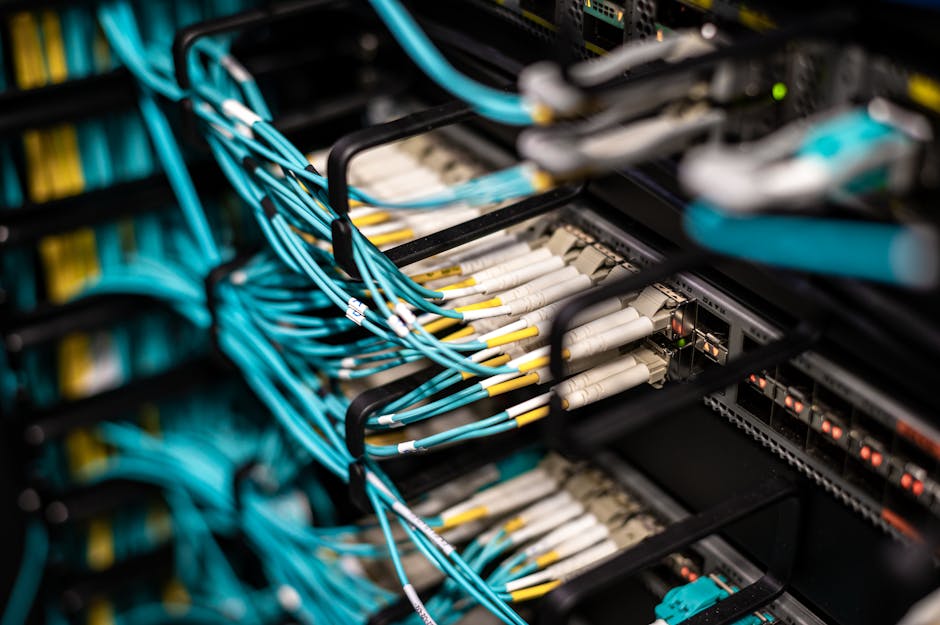
- Infrastructure Beyond the Chip: Effective AI scaling depends equally on high-speed interconnects (e.g., NVLink, InfiniBand), fast storage (NVMe-oF), and efficient power delivery, not just the accelerator itself.
- Cloud vs. On-Premise is a Cost-Benefit Analysis: Cloud platforms offer flexibility and immediate scale, ideal for burst workloads or initial development. On-premise provides greater control and potentially lower long-term cost for stable, high-utilization workloads, but demands significant upfront investment and operational expertise.
- VRAM and Bandwidth Dictate Performance: For LLMs and complex models, VRAM capacity and memory bandwidth are often more critical than raw FLOPS, directly impacting model size, batching, and inference latency.
The Foundation of Enterprise AI: Understanding High-Performance AI Infrastructure

At Krapton, we define high-performance AI infrastructure as the integrated ecosystem of specialized hardware, networking, and storage components meticulously selected and configured to meet the demanding requirements of enterprise-grade artificial intelligence workloads. This isn't just about a single powerful GPU; it's about the entire stack working in concert to deliver optimal throughput, low latency, and cost efficiency for tasks ranging from foundational model training to real-time, large-scale inference.
The landscape of AI innovation moves at an incredible pace, driven by advancements in models like large language models (LLMs) and diffusion models. These models, often comprising billions or even trillions of parameters, necessitate compute resources far exceeding those of conventional servers. Without a robust high-performance AI infrastructure, even the most innovative algorithms can be bottlenecked, leading to protracted training times, prohibitive inference costs, or an inability to deploy at scale.
GPU Accelerators: The Workhorses of Modern AI
At the heart of any high-performance AI infrastructure are the accelerators, primarily Graphics Processing Units (GPUs), specifically designed for parallel computation. While consumer GPUs can handle smaller AI tasks, enterprise-grade AI demands purpose-built accelerators that offer significantly higher VRAM, memory bandwidth, and specialized compute cores.
NVIDIA H100/H200: Dominating the Datacenter
NVIDIA's Hopper architecture, exemplified by the H100 and its successor, the H200, represents the pinnacle of AI acceleration. The NVIDIA H100 Tensor Core GPU boasts massive FP8 and FP16 throughput, crucial for deep learning training. The H200 further extends this with increased HBM3e memory, pushing VRAM capacity and bandwidth even higher, which is critical for hosting larger LLMs and managing larger batch sizes during inference. These units are not standalone; they are designed to be interconnected via high-speed NVLink, allowing multiple GPUs to act as a single, massive accelerator for multi-billion parameter models.
AMD Instinct MI300 Series: A Formidable Contender
AMD has emerged as a strong competitor with its Instinct MI300 series, particularly the MI300X accelerator. Leveraging a chiplet design, the MI300X integrates a substantial amount of HBM3 memory and offers compelling performance for both training and inference workloads. Its open software ecosystem through ROCm is attractive for teams seeking alternatives to NVIDIA's CUDA. For large-scale LLM inference, the MI300X's memory capacity and bandwidth make it a highly viable option.
In a recent client engagement focused on fine-tuning a 70B parameter LLM, we initially underestimated the memory bandwidth requirements for efficient batch processing during inference. While VRAM capacity was sufficient, the slower interconnects between GPUs became a bottleneck, leading to unacceptable latency. Optimizing the data pipeline and, ultimately, upgrading to faster NVLink-enabled systems for multi-GPU inference significantly reduced per-token generation time by over 30%, directly impacting user experience and operational cost. This reinforced our understanding that raw VRAM alone isn't enough; the speed at which that memory can be accessed and shared is equally vital.
Beyond the GPU: Networking, Storage, and Compute
A single accelerator, no matter how powerful, is only as effective as the infrastructure surrounding it. High-performance AI infrastructure requires a holistic approach:
- High-Speed Interconnects: For multi-GPU systems, technologies like NVIDIA NVLink and InfiniBand are indispensable. These provide low-latency, high-bandwidth communication paths between GPUs and across nodes, preventing bottlenecks that can cripple distributed training or large-scale inference. Without them, the cumulative power of multiple accelerators cannot be fully realized.
- Fast Storage: AI workloads are incredibly data-intensive. Training datasets can range from terabytes to petabytes. NVMe-oF (NVMe over Fabrics) storage solutions, combined with parallel file systems, ensure that data can be fed to the GPUs at speeds that match their hunger for information. Traditional network-attached storage (NAS) or even local SATA SSDs simply cannot keep up, leading to I/O bound training loops.
- Powerful CPUs: While GPUs handle the heavy lifting of tensor operations, CPUs (e.g., AMD EPYC, Intel Xeon, or ARM-based cloud engineering services like AWS Graviton) are essential for data pre-processing, orchestrating training jobs, managing operating systems, and handling non-AI specific application logic. A balanced system prevents the CPU from becoming a bottleneck for the GPUs.
- Robust Power and Cooling: High-performance accelerators consume significant power and generate substantial heat. Datacenter-grade power delivery and advanced cooling solutions (liquid cooling is becoming common for extreme densities) are non-negotiable for stable and efficient operation.
Like this article? Help us grow.
Choose Krapton as a preferred source on Google to see more of our engineering insights in Search. You only need to click once.
Cloud vs. On-Premise: The Strategic Deployment Decision
Choosing between cloud-based AI platforms and dedicated on-premise infrastructure is a critical decision driven by cost, control, scalability, and specific workload characteristics.
- Cloud AI Platforms: Hyperscalers like AWS, Google Cloud, and Azure offer on-demand access to the latest accelerators (NVIDIA H100, custom TPUs, etc.) without significant upfront capital expenditure. This elasticity is ideal for fluctuating workloads, initial prototyping, or burst capacity needs. You pay for what you use, and management overhead is minimal. However, for consistent, high-utilization workloads, cumulative costs, especially egress fees and hourly instance rates, can quickly outweigh the benefits.
- On-Premise Infrastructure: Building your own AI datacenter provides maximum control over hardware, software stack, security, and data locality. For steady-state, high-volume training or inference, on-premise can offer a lower total cost of ownership (TCO) over several years. The trade-off is substantial upfront investment, longer deployment times, and the need for in-house expertise in hardware procurement, installation, and ongoing maintenance.
On a production rollout for an AI-powered content generation platform, we faced the classic cloud vs. on-prem dilemma. Initially, leveraging hyperscaler GPU instances provided rapid prototyping and burst capacity. However, as daily inference volume grew consistently to hundreds of millions of tokens, our team measured that the egress costs and hourly instance rates for steady-state workloads quickly surpassed the amortized cost of dedicated on-prem hardware. We then made the strategic decision to transition high-volume inference to a self-managed cluster, which involved careful planning for power, cooling, and network redundancy, but ultimately yielded a 40% reduction in monthly compute expenditure for that specific workload.
When NOT to Over-Engineer Your AI Infrastructure
While high-performance AI infrastructure is critical for demanding enterprise workloads, it's not always the immediate answer. For initial prototypes, small-scale research, or applications with low, infrequent inference demands, leveraging managed cloud AI services or even consumer-grade GPUs might be more cost-effective and faster to deploy. The significant upfront capital expenditure and ongoing operational overhead associated with building and maintaining a dedicated high-performance cluster only justify themselves when consistent, high-volume, or latency-sensitive workloads demonstrate a clear return on investment over cloud alternatives.
Key Hardware Comparison for Enterprise AI
This table compares leading AI accelerators based on critical specifications for enterprise workloads as of 2026. Prices are rough estimates and can vary significantly based on vendor, volume, and supply chain dynamics.
| Accelerator | VRAM (Capacity) | Memory Bandwidth | Interconnect | Typical Price Tier (per unit) | Best For |
|---|---|---|---|---|---|
| NVIDIA H100 PCIe | 80 GB HBM3 | 3.35 TB/s | PCIe Gen5, NVLink | High-End Enterprise | Large model training, multi-GPU inference, high-performance computing |
| NVIDIA H200 PCIe | 141 GB HBM3e | 4.8 TB/s | PCIe Gen5, NVLink | Premium Enterprise | Ultra-large LLM training & inference, memory-bound workloads |
| AMD Instinct MI300X | 192 GB HBM3 | 5.3 TB/s | PCIe Gen5, Infinity Fabric | High-End Enterprise | Large LLM inference, training with ROCm ecosystem, memory-intensive tasks |
| NVIDIA A100 PCIe | 40/80 GB HBM2 | 1.5-2.0 TB/s | PCIe Gen4, NVLink | Mid-Range Enterprise | General AI training & inference, cost-effective scaling (previous gen) |
| NVIDIA RTX 6000 Ada (Pro) | 48 GB GDDR6 | 1.1 TB/s | PCIe Gen4, NVLink (2-way) | Workstation/Prosumer | Developer workstations, fine-tuning smaller models, local AI development |
Building Your AI Infrastructure: Recommendations by Use Case and Budget
Selecting the right high-performance AI infrastructure is highly dependent on your specific use case, budget, and long-term strategy. Here are some common scenarios:
- Early-Stage Prototyping & Development: For initial experiments or single-developer setups, a high-end workstation with an NVIDIA RTX 6000 Ada or even a powerful consumer GPU (like an RTX 4090) can suffice. Leverage cloud services for occasional burst training.
- Large Model Fine-Tuning & Small-Scale Training: Consider a small cluster of NVIDIA A100s or AMD MI250s (previous generation but still powerful) in the cloud or a modest on-prem setup. Prioritize VRAM and memory bandwidth.
- Enterprise LLM Inference at Scale: This requires a balance of VRAM capacity, memory bandwidth, and efficient batching. AMD MI300X and NVIDIA H100 are top contenders. Focus on high-speed interconnects and optimized software stacks. Krapton's AI development services can help design and implement these complex inference systems.
- Foundational Model Training & Research: For cutting-edge model development, NVIDIA H200s or large clusters of H100s/MI300X via NVLink/InfiniBand are essential. This is typically a multi-million dollar investment, often best handled by specialized cloud providers or dedicated on-prem data centers with significant operational expertise.
Regardless of your chosen path, the key is to perform a thorough cost-benefit analysis, considering both capital expenditure and operational costs, including power, cooling, and maintenance. Don't forget the software stack; optimizing frameworks like PyTorch or TensorFlow, and leveraging tools like DeepSpeed or FSDP, can dramatically improve hardware utilization and model performance. Our team of Python developers and ML engineers specializes in these optimizations.
FAQ
What is the most critical spec for LLM inference hardware?
For LLM inference, VRAM capacity and memory bandwidth are typically the most critical specifications. VRAM determines the largest model size and batch size you can load, while memory bandwidth dictates how quickly the model's parameters can be accessed, directly impacting token generation speed and overall latency.
Is on-premise AI infrastructure still relevant in the cloud era?
Yes, on-premise AI infrastructure remains highly relevant, especially for organizations with stable, high-volume AI workloads, strict data sovereignty requirements, or specific security compliance needs. While cloud offers elasticity, on-premise can yield a lower total cost of ownership for consistent, high utilization over several years.
How does networking impact AI performance?
High-speed, low-latency networking is crucial for distributed AI workloads. Technologies like NVLink and InfiniBand enable multiple GPUs to communicate efficiently, preventing bottlenecks during multi-GPU training or large-scale inference. Slow networks can negate the benefits of powerful accelerators, leading to underutilized hardware and longer processing times.
Can consumer GPUs be used for enterprise AI?
Consumer GPUs like the NVIDIA RTX 4090 can be suitable for individual developer workstations, small-scale fine-tuning, or initial prototyping. However, they lack the VRAM capacity, memory bandwidth, specialized interconnects (like NVLink for multi-GPU scaling), and robust enterprise support required for production-grade, high-performance AI infrastructure.
Ready to Scale Your AI Ambitions?
Architecting and implementing high-performance AI infrastructure is a complex undertaking that demands deep expertise in hardware, software, and operational realities. If your enterprise is grappling with scaling AI models, optimizing inference costs, or building a robust AI foundation, Krapton is here to help. Book a free consultation with Krapton to discuss your unique challenges and explore how our dedicated engineering teams can accelerate your AI journey.