A Lighthouse score tells you that you have a problem. It almost never tells you which line of code caused it, or what fixing it is actually worth. That gap is where most performance and SEO work stalls. VitalsLens closes it.
TL;DR: VitalsLens is a Core Web Vitals, technical SEO, on-page SEO and accessibility auditor that returns a prioritised, code-level fix list instead of a vague score. It tracks regressions per commit across staging and production, validates schema markup, and pushes Slack or email alerts the moment a metric slips. SEO and performance, finally on one dashboard.
What VitalsLens actually is
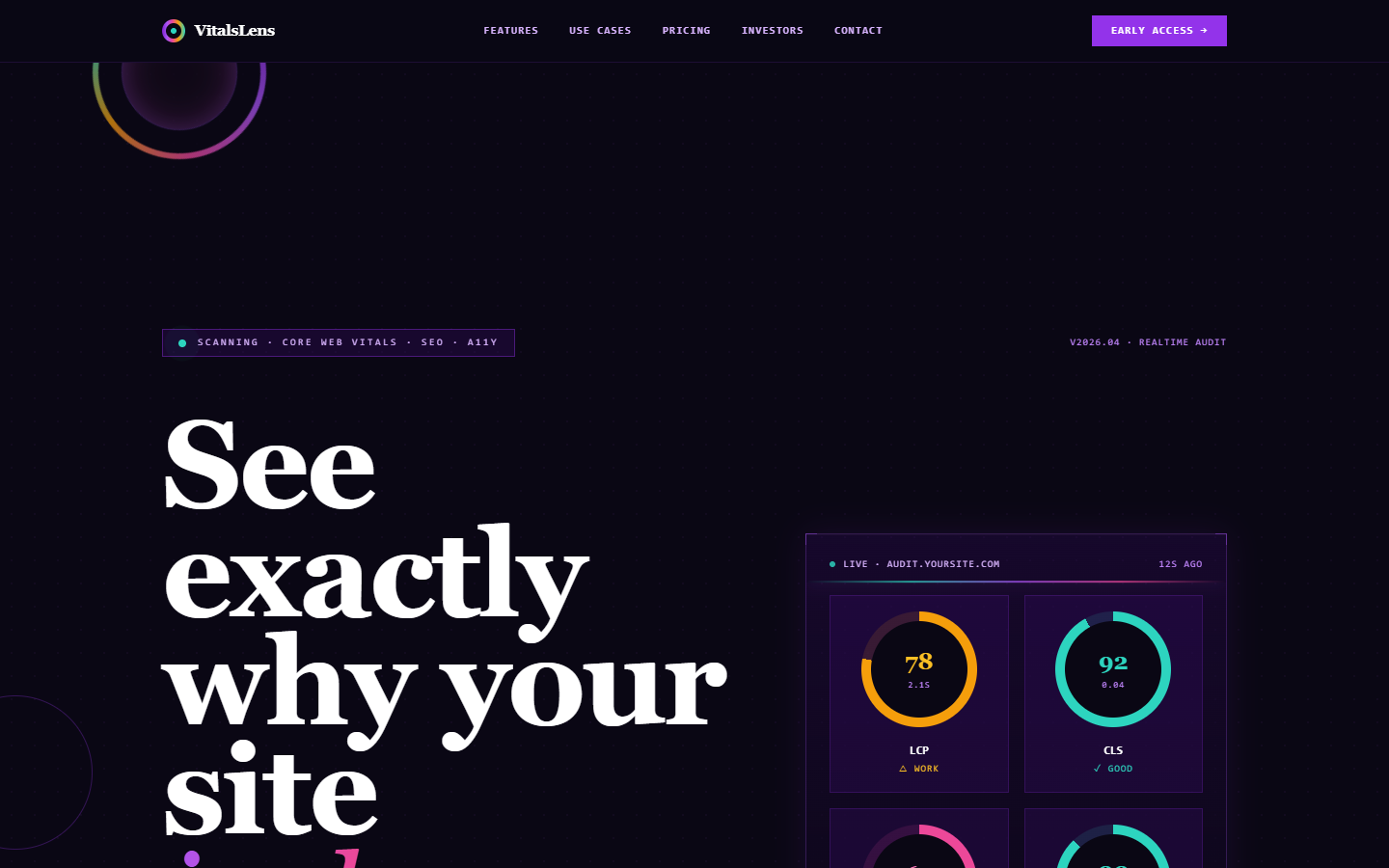
VitalsLens is a website auditing tool built for teams that ship constantly. It runs your pages against four pillars at once: Core Web Vitals (LCP, INP, CLS), technical SEO, on-page SEO, and accessibility. Where most tools hand you a number between 0 and 100 and leave you to guess, VitalsLens returns specific, line-level recommendations with the expected impact on LCP, CLS or INP attached to each one.
That framing matters. A score is a symptom; a fix list is a plan. The product is designed so an engineer can open a report, read the top three items, and know exactly what to change and roughly what it will buy them in milliseconds. It is currently in development at the VitalsLens product page, with continuous monitoring as the headline capability.
The problem it solves
Performance and SEO regressions are quiet failures. A new hero image ships without dimensions and CLS doubles. A third-party tag lands on the main thread and INP slides into the red. A canonical tag gets dropped in a refactor and a page falls out of the index. None of these throw an error. None of them break a test. They just slowly cost you ranked traffic until someone notices the analytics dip weeks later.
In our experience, the teams who get hurt most are the ones moving fast. The faster you ship, the more surface area there is for a vitals regression to slip through. VitalsLens treats performance and SEO the way you already treat tests: as something checked on every change, not audited once a quarter when rankings have already dropped.
Who it is for
VitalsLens is built for product engineering teams, technical SEO specialists, and agencies who own the health of a site they did not write all of in one sitting. If you ship to staging and production regularly, run on a modern stack like Next.js or Node.js, and care about organic traffic, it fits cleanly into how you already work.
- Engineering teams who want vitals checked in the same loop as code review, not in a separate quarterly audit.
- Technical SEO specialists who need schema, indexability and on-page signals validated continuously, not eyeballed.
- Agencies managing many client sites who need shareable, defensible reports that prove the work moved a metric.
Key capabilities
The feature set is deliberately focused on the things that move rankings and conversion, and nothing that does not.
- Full Core Web Vitals audit covering LCP, INP and CLS, each tied to a concrete cause and a fix.
- Technical SEO scan that surfaces actionable issues rather than a checklist of pass/fail lights.
- Per-commit regression tracking so a slip is attributed to the change that caused it.
- On-page SEO and schema-markup validation that catches broken meta tags and missing JSON-LD before they ship.
- Competitor benchmarking so a score has context, not just an absolute number.
- Accessibility (WCAG) auditing alongside performance, because the two overlap more than most teams expect.
- Slack and email regression alerts that fire the moment a metric crosses a threshold.
- Public, shareable audit reports for clients, stakeholders or your own team.
How it works under the hood
VitalsLens is built on a Next.js front end with a Node.js auditing backend, and it leans on the Lighthouse engine for the heavy lifting on Core Web Vitals. Rather than treating each audit as an isolated snapshot, it stores results over time and diffs them, which is what makes per-commit regression tracking possible: every report is anchored to a point in your history, so a jump in CLS or a drop in INP can be traced back to the change that introduced it.
You can run it two ways. One-off audits are useful for a quick health check on a single URL. Continuous monitoring is where the product earns its place: point it at staging and production, set your thresholds, and let it watch. When a metric regresses or a meta tag breaks, the alert reaches Slack or email before the regression reaches your users. If you want this kind of monitoring wired into a delivery pipeline, our DevOps and CI/CD engineering services cover exactly that integration work.
A real-world usage scenario
Picture a content-heavy marketing site that ships several times a week. A designer swaps the homepage hero for a larger, unoptimised image. The deploy goes green, the page looks fine, and nobody notices that LCP has crept from 2.2 seconds to 3.4. Two weeks later, organic traffic to the homepage is down and nobody can say why.
With VitalsLens watching production, that same change triggers an alert within minutes of the deploy: LCP regressed on the homepage, attributed to the commit, with the oversized hero image named and a fix recommended. The team adds explicit dimensions and a priority hint, re-runs the audit, and watches the metric return to green on the same dashboard. The regression never costs a single ranked position because it never survived past the day it shipped.
Who this is not for
VitalsLens is honest about its boundaries. If you run a small static brochure site that changes a few times a year, continuous monitoring is more machinery than you need; a periodic manual audit will serve you fine. It is also not a content strategy or keyword-research tool. It tells you why a page is technically slow or structurally broken and how to fix it. It will not write your articles or pick your target keywords. It is a precision instrument for technical performance and SEO health, and that focus is the point.
FAQ
What is the difference between a Lighthouse score and VitalsLens?
Lighthouse gives you a score and a list of audits. VitalsLens runs on top of that data and turns it into a prioritised, code-level fix list, with the expected LCP, CLS or INP impact attached to each item. It also tracks results over time per commit, so you see not just where you are but what changed and what caused it.
Can VitalsLens monitor staging and production at the same time?
Yes. You can run one-off audits on any URL, or set up continuous monitoring across both staging and production. It tracks regressions commit by commit and sends Slack or email alerts the moment a metric slips or a meta tag breaks, so issues are caught before or shortly after they ship rather than weeks later.
Does VitalsLens cover SEO as well as performance?
It does. Alongside Core Web Vitals, VitalsLens runs technical SEO scans, validates on-page SEO and schema markup, flags missing or broken meta tags, and audits accessibility against WCAG. Putting performance and SEO on a single dashboard is the whole idea, since the two share many of the same underlying causes.
What tech stack does VitalsLens use?
VitalsLens is built on Next.js and Node.js, with the Lighthouse engine powering its Core Web Vitals measurements. The architecture stores audit history so it can diff results across commits, which is what enables per-commit regression tracking and the time-series view of how a site's vitals trend.
Try VitalsLens or build something like it
If keeping Core Web Vitals and SEO green on every deploy is a problem you live with, VitalsLens is built for you. Read the full overview on the VitalsLens product page, or follow it toward launch at vitalslens.krapton.com. Want a custom performance or monitoring tool built around your own pipeline? You can hire a dedicated Krapton team to design and ship it.