StakeClash asked us to build the front door for something genuinely hard: a platform where competitive gamers stake real cash on the matches they play, settle it on-chain, and trust that the money is handled correctly. That is a category where a slow, vague, or sketchy-feeling website kills the deal before a wallet is ever connected. So we built a fast, content-driven Next.js experience designed to make a wager-based gaming platform feel as legitimate as the stakes it carries.
TL;DR: Krapton designed and shipped StakeClash's web platform on Next.js with Firebase and Redux, wired up real analytics, and tuned it for Core Web Vitals and SEO. The result is a fast, trustworthy front end for a blockchain-backed competitive-gaming product where players stake cash on the games they play, compete, and unlock earnings every match.
What StakeClash is
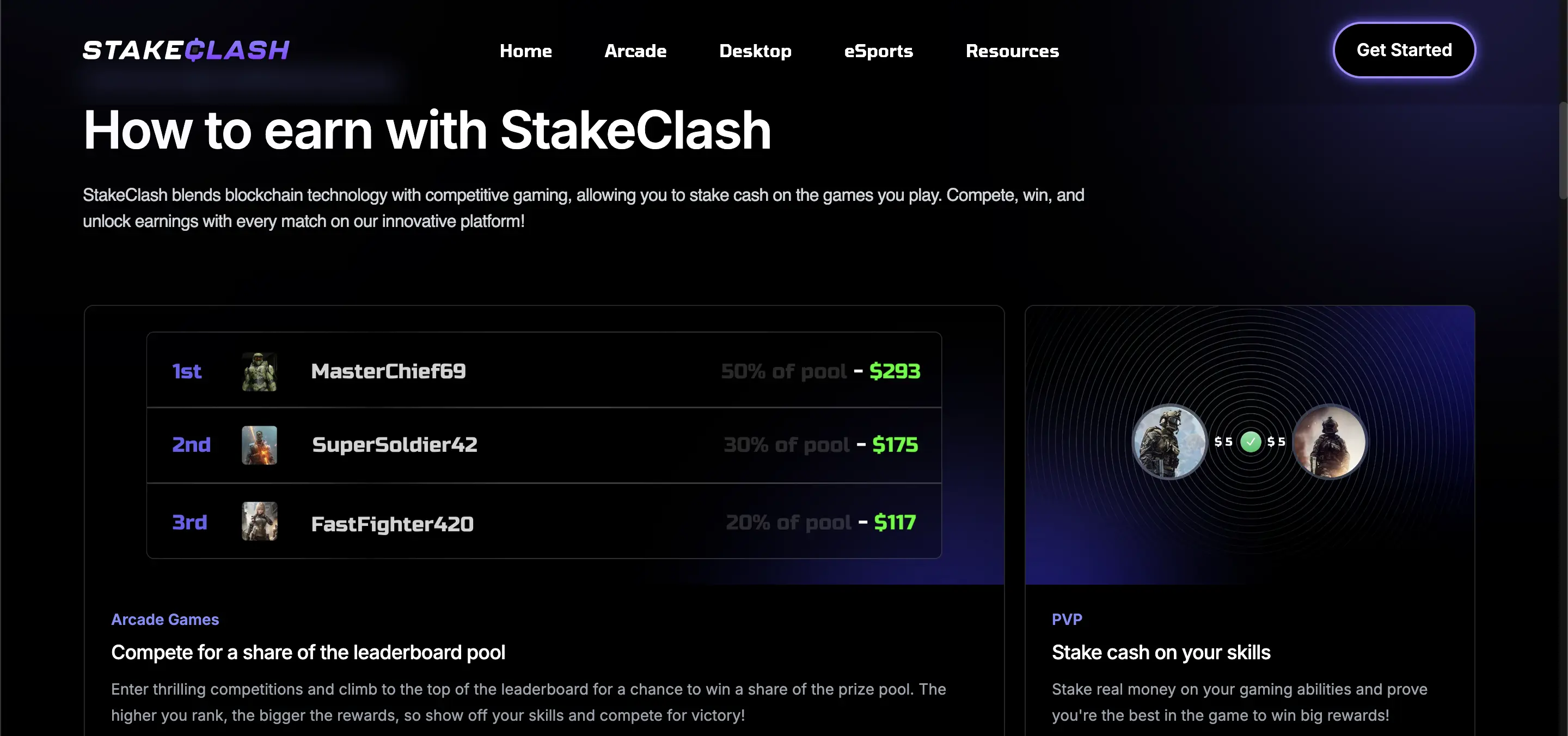
StakeClash blends blockchain technology with competitive gaming. The core idea is simple to say and surprisingly demanding to build: you stake cash on the games you already play, you compete head to head, and you unlock earnings with every match. Win and your stake grows; the platform turns casual skill into something with real consequences.
That premise puts StakeClash at the intersection of three worlds that rarely share a codebase — real-money handling, on-chain settlement, and the fast, reactive UX that gamers expect. Each of those audiences arrives with a different reflex. Gamers want speed and zero friction. People moving money want signals of trust and clarity about what happens to their funds. The web layer has to satisfy both in the first few seconds.
The problem we were solving
The brand had a strong proposition but needed a digital home that could carry it. When real cash is on the line, hesitation is the enemy. A confusing layout, a janky load, or a page that feels improvised reads as a reason not to deposit. The brief was effectively a trust-and-speed problem disguised as a website.
- Communicate a complex stake-compete-earn loop in seconds, to a sceptical first-time visitor.
- Stay fast under bursty, social-driven traffic — the kind a competitive-gaming launch attracts.
- Make wallet, account, and match state feel instant rather than spinner-heavy.
- Be discoverable in search for a brand-new product nobody was looking for yet.
In our experience, products in regulated-adjacent or money-adjacent spaces live and die on perceived credibility. Performance and polish are not cosmetic here; they are the trust signal.
What Krapton designed and built
We delivered StakeClash's web platform as a content-driven Next.js application — the marketing surface that explains the proposition plus the connective tissue into the staking and competition experience. The design language leans into the energy of competitive play while keeping money-related flows calm, explicit, and uncluttered, so the parts of the journey that involve cash never feel rushed or hidden.
Every section earns its place: the stake-compete-earn loop is explained progressively rather than dumped on the visitor, calls to action sit exactly where intent peaks, and the layout holds together across phone, tablet, and desktop because most of this audience arrives on mobile mid-session.
Under the hood: the tech approach
The stack was chosen to match the demands of a real-money, real-time product rather than a brochure site.
- Next.js for a fast, content-driven front end — pre-rendered where it pays off for speed and crawlability, dynamic where the experience needs to react to the player.
- Firebase as the backbone for authentication and real-time state, so account and match data can update live without heavy custom infrastructure.
- Redux to keep client state predictable across wallet status, session, and match context — essential when the UI reflects money that is in play.
- Analytics wired in from day one so the team can see how real visitors move through the stake-compete-earn funnel and where they drop off.
- Core Web Vitals and SEO treated as first-class engineering goals, not an afterthought — because both directly affect whether a stranger trusts the page enough to stay.
The principle throughout: blockchain and competitive gaming bring enough complexity on their own, so the web layer should be boringly reliable and genuinely fast. If you want this kind of build for your own product, this is the heart of our website development service.
Why the result matters
For a platform where users put cash behind their gameplay, the website is the moment trust is won or lost. A front end that loads instantly, explains the loop clearly, and behaves like a serious product makes the leap from visitor to player feel safe. Tight Core Web Vitals and clean SEO mean the brand can actually be found and, just as importantly, feels fast the instant someone lands.
You can visit the live site to see how the stake-compete-earn experience comes together, and explore the full StakeClash case study for more on the build.
Who this is (and is not) for
This story is most useful if you are shipping a money-adjacent or real-time product where credibility and speed decide whether users commit — fintech-flavoured platforms, competitive gaming, marketplaces, anything blending on-chain settlement with a consumer front end. It is less relevant if you only need a simple static brochure with no live state, no transactions, and no trust-sensitive flows; that is a lighter build than what StakeClash required, and we would tell you so rather than oversell it.
FAQ
What is StakeClash?
StakeClash is a platform that blends blockchain technology with competitive gaming. Players stake cash on the games they play, compete in matches, and unlock earnings as they win. Krapton designed and built its Next.js web platform, backed by Firebase and Redux, and tuned for performance and search.
What tech stack did Krapton use to build StakeClash?
StakeClash runs on a Next.js front end with Firebase for authentication and real-time data, Redux for predictable client state, and analytics wired in for funnel insight. The build was engineered specifically for Core Web Vitals and SEO so a brand-new, money-sensitive product loads fast and earns trust quickly.
How do you build trust into a real-money gaming platform?
Trust comes from clarity and speed. We explain the stake-compete-earn loop progressively, keep money-related flows calm and explicit, and treat performance as a credibility signal. Fast loads, stable layouts, and a polished, predictable interface tell a first-time visitor that their funds are handled by a serious product.
Can Krapton build a similar blockchain or competitive-gaming platform for us?
Yes. We build content-driven, real-time web platforms for money-adjacent and on-chain products, pairing Next.js with the right backend and state layer. Browse our other case studies to see the range, then tell us what you are shipping.
Build your platform with Krapton
If you are launching a product where speed and trust decide whether users commit, Krapton can design and ship the web experience that carries it. We turned StakeClash's stake-compete-earn proposition into a fast, credible Next.js platform — and we can do the same for yours. Hire a dedicated Krapton team to take your idea from brief to launch.