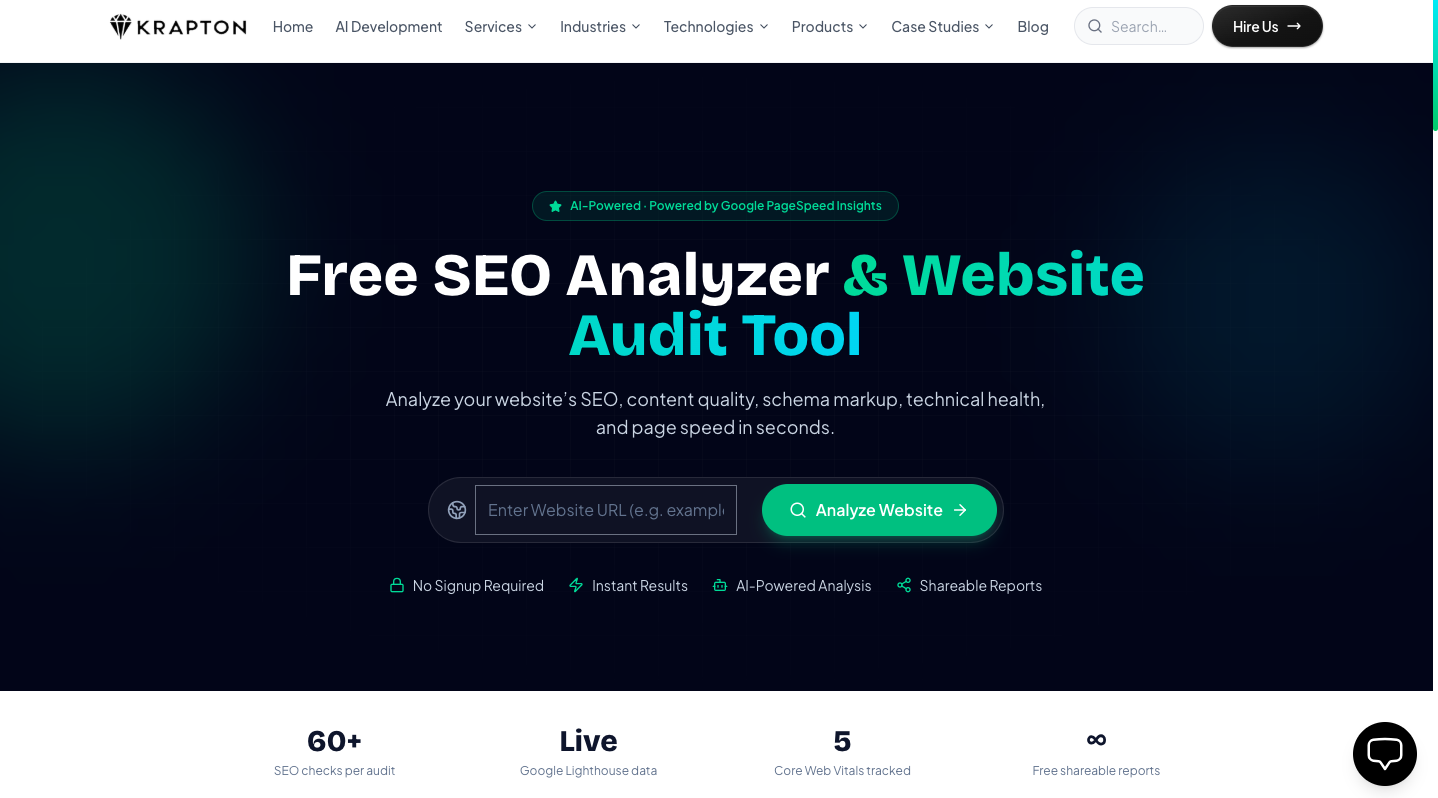
Most sites lose rankings quietly. A slow Largest Contentful Paint, a broken canonical, or missing schema can suppress organic traffic for months before anyone notices the dip in their analytics. Krapton's SEO Analyzer is the fastest way to find out what is actually wrong with your site — paste a URL and get a graded, prioritized audit in seconds, free, with no signup.
TL;DR: Krapton's free SEO Analyzer runs a full website audit — on-page SEO, technical health, Core Web Vitals, structured data and content quality — built on Google PageSpeed Insights and an AI recommendation engine. It surfaces critical issues with the exact fix for each, ranks quick wins by impact, and produces a permanent, shareable report. No credit card, results in seconds.
What the SEO Analyzer Actually Is
SEO Analyzer is a free, instant website audit tool that lives on krapton.com. You enter any public URL and it returns a comprehensive report spanning five graded categories: SEO, performance, technical, content and schema. There is no account to create, no trial countdown, and no upsell wall between you and the results — you see the full report in seconds.
The point is to replace the scattered, half-finished audit most teams do by hand. Instead of opening five separate tools, copying numbers into a spreadsheet, and still missing the issues that matter, you get one report that grades the whole stack of ranking signals at once and tells you which problems to fix first.
The Problem It Solves
SEO problems are expensive precisely because they are invisible. The site looks fine in the browser. Pages load. Nothing is obviously broken. Meanwhile a render-blocking script is wrecking your Interaction to Next Paint, your product pages ship without JSON-LD, and your meta descriptions are duplicated across forty URLs — and none of it shows up until rankings have already slipped.
Most owners only audit reactively, after traffic drops, and even then the tooling is a problem. Generic checkers hand you a single vanity score with no path to action. Enterprise platforms are powerful but slow, gated behind onboarding and a sales call. Neither is something you can run in the two minutes before a deploy.
- You do not know which of fifty findings actually moves the needle.
- You cannot easily share a result with a client or a teammate.
- You have no clean way to re-run later and confirm a fix landed.
SEO Analyzer is built for exactly that gap: a credible, full-spectrum audit you can run instantly, share with a permanent link, and revisit to track progress over time.
Who It Is For
The tool is aimed at the people who own outcomes but do not have a dedicated SEO team behind them. In our experience the same audit serves several audiences at once, which is deliberate.
- Founders and marketers who need a plain-language read on whether their site is healthy, without learning Lighthouse internals.
- Developers shipping a Next.js or React app who want a fast technical sanity check before and after a release.
- Agencies and freelancers who need a clean, shareable report to hand a client as proof of work or as a pitch artifact.
If you run a website and care whether Google can crawl, render and rank it, you are in scope.
Key Capabilities
Every report covers the full set of signals that decide how a page performs in search, not just the surface-level meta tags. The checks fall into clear groups.
- On-page SEO — titles, meta descriptions, heading hierarchy and image attributes, all graded against current best practice.
- Technical SEO — HTTPS, robots.txt, sitemap presence, indexability and broken-link detection.
- Core Web Vitals and PageSpeed — real Lighthouse scores via Google, so the performance grade reflects what Google itself measures.
- Structured data — JSON-LD schema validation, so you catch missing or malformed markup that is costing you rich results.
- Content quality — readability and keyword analysis to flag thin or unfocused pages.
- AI executive summary — a prioritized recommendation list and quick wins ranked by impact, so the report ends with a to-do list, not just a verdict.
Crucially, every critical issue ships with the exact fix for that issue. The report is designed to be acted on, not just admired.
How It Works Under the Hood
The performance and Core Web Vitals grade is powered by Google PageSpeed Insights, so the numbers you see are Google's own Lighthouse measurements rather than a homegrown approximation. That matters: an audit that disagrees with Google is an audit you cannot trust before a launch. On top of that real performance data, the analyzer layers its on-page, technical, content and schema checks, then feeds the combined findings into an AI recommendation engine that writes the executive summary and ranks the quick wins by expected impact.
The front end is a fast Next.js application — the same stack our team reaches for when building high-performance marketing sites — which keeps the tool itself quick and lets results render the moment the audit completes. Every report is persisted at a permanent public URL, so the link you share today still resolves weeks later when you want to compare against a fresh run.
A Real-World Scenario
Say you are about to ship a redesign. The night before launch you paste the staging URL into the SEO Analyzer. The report grades performance as borderline and flags two critical items: the hero image is loading without priority and is dragging LCP, and the new product template ships with no JSON-LD at all. It also lists three quick wins — a missing meta description on the pricing page, a non-self-referencing canonical, and an oversized title tag.
You fix the priority hint, add Product schema, and clear the quick wins in under an hour. After deploy you re-run the audit on production, the grades move into the green, and you send the permanent report link to your client as proof the launch is clean. That loop — audit, fix the highest-impact item, re-run, share — is the entire workflow the tool is built around.
Who this is (and is not) for
SEO Analyzer is an honest fit for fast, recurring health checks and pre-launch sanity passes. It is not a replacement for an ongoing rank-tracking suite, a backlink database, or a full enterprise SEO platform with crawl scheduling and historical dashboards — it does not pretend to be. If you need continuous monitoring across staging and production with regression alerts, that is a heavier job than a free instant audit is meant to do. For a clear, actionable snapshot you can run any time and share with anyone, it is exactly the right tool.
FAQ
Is the SEO Analyzer really free?
Yes. SEO Analyzer is free to use with no signup and no credit card. You enter a URL and get the full report in seconds, including the AI summary and prioritized fixes. There is no trial limit gating the results — the complete audit, across all five categories, is available on the first run.
How accurate are the performance scores?
The performance and Core Web Vitals grades come from Google PageSpeed Insights, so they reflect Google's own Lighthouse measurements rather than an independent estimate. That is deliberate: the scores you act on are the same ones Google uses to assess page experience, which keeps the audit credible before a launch.
Can I share the SEO report with a client or my team?
Every audit generates a permanent, shareable public report at its own link. You can send that link to a client as proof of work, hand it to a teammate to action the fixes, or revisit it yourself later to compare against a fresh run and confirm progress over time.
Does it tell me how to fix the issues it finds?
Yes. The report is built to be acted on. Each critical issue is paired with the exact fix for it, and the AI executive summary closes with quick wins ranked by impact, so you always know which change to make first rather than staring at an undifferentiated list of findings.
Run Your First Audit
Stop guessing why your rankings are flat. Open Krapton's SEO Analyzer and audit any URL for free, then read the full breakdown on the SEO Analyzer product page. If you would rather have specialists fix what the report finds, hire a dedicated Krapton team to handle the implementation end to end.