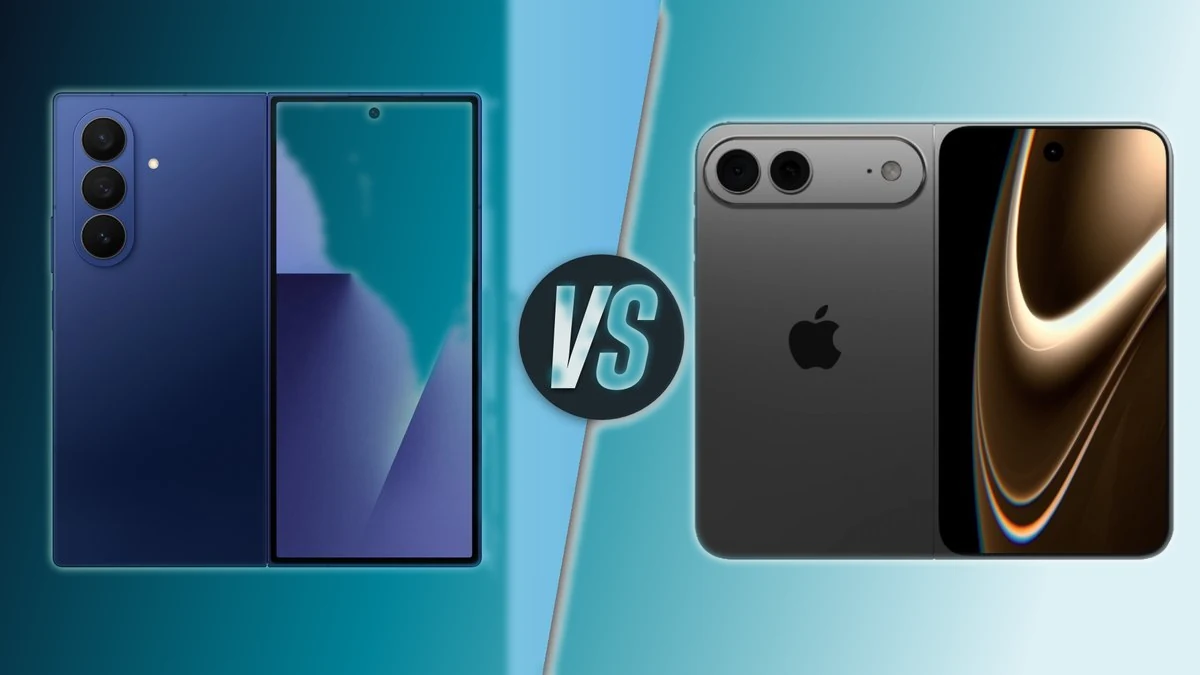
The Foldable Clash: iPhone 18 Fold (Leaks) vs. Samsung Galaxy Z Fold 7
For years, Samsung has enjoyed a near-monopoly on the premium foldable smartphone segment. However, 2026 is turning out to be the ultimate battleground. Supply chain leaks strongly indicate that Apple is poised to enter the ring with its first-ever folding device, tentatively dubbed the iPhone 18 Fold (or iPhone Ultra).
As software engineers and product architects, we look at these devices not just as luxury hardware, but as completely different philosophies in mobile display scaling and computation. Here is how Apple’s rumored entry stacks up against the newly crowned Samsung Galaxy Z Fold 7.
The Architectural Specs at a Glance
| Spec Layer | Samsung Galaxy Z Fold 7 | iPhone 18 Fold (Expected) |
|---|---|---|
| Form Factor | Tall book-style (10:9 inner aspect ratio) | Wide passport-style (~4:3 inner ratio) |
| Display Size | 8.0-inch Main / 6.5-inch Cover | ~7.8-inch Main / ~5.5-inch Cover |
| Silicon Architecture | Snapdragon 8 Elite (3nm node) | Apple A20 (Next-Gen 2nm node) |
| RAM/Memory | 12GB or 16GB LPDDR5X | 12GB LPDDR6 |
| Primary Camera | 200MP Flagship Triple Array | 48MP Dual Lens System (No Telephoto) |
| Crease Control | Highly minimized physical indentation | Custom chemical-etched 'crease-free' panel |
1. The Form Factor Philosophy: Passport vs. Book
Samsung has spent seven generations perfecting its tall, remote-control-like cover screen that opens up into a massive 8.0-inch tablet. It is optimized for vertical scrolling and split-screen web browsing.
Apple is reportedly taking a leaf out of the Google Pixel Fold playbook, opting for a shorter, wider "passport" aspect ratio. When unfolded, the application UI doesn't require aggressive responsive stretching—it scales down comfortably like an iPad mini, making it incredibly native for media consumption and dual-column layouts.
2. Next-Gen Nodes: 3nm vs. 2nm Silicon
The Galaxy Z Fold 7 is an absolute processing powerhouse, running on Qualcomm’s Snapdragon 8 Elite built on a refined 3nm process. It handles local Galaxy AI tasks and heavy desktop environments (Samsung DeX) seamlessly.
However, the iPhone 18 Fold is expected to leapfrog current engineering standards by utilizing TSMC’s bleeding-edge 2nm A20 system-on-a-chip. Packing more density into a smaller space allows Apple to build an incredibly thin chassis (~4.5mm when open) while managing thermal throttling—the ultimate enemy of foldable hardware.
3. The Crease Problem
While Samsung has steadily reduced the visible center line with its upgraded hinge structures, the crease is still tactile. Apple’s delay in entering this market stems entirely from its perfectionism regarding display mechanics. Leaks suggest Apple has engineered a custom variable-thickness ultra-thin glass (UTG) assembly that renders the display completely smooth to both the eye and touch.
The Krapton Verdict: Which Ecosystem Wins?
If you need an ultra-mature multi-window multitasking machine with a desktop-grade 200MP camera and S-Pen stylus support, the Galaxy Z Fold 7 remains unrivaled. It is a true enterprise workstation.
But if you are heavily invested in the iOS ecosystem and have been waiting for a device that seamlessly shifts your workspace from mobile to a pocketable tablet layout without compromising on build sleekness, the iPhone 18 Fold will likely be the definitive benchmark shift of the decade.
Building the Future of Adaptive Apps
Whether it’s optimizing responsive layouts for tall folding screens or scaling asset delivery for multi-window tablets, mobile application architecture requires forward-thinking UI/UX and performance tuning. At Krapton, we build apps that leverage the hardware of tomorrow.
Krapton Engineering Insights
Technical deep-dives and hardware analysis brought to you by the mobile application design and system architecture teams at Krapton Technologies.