In F1 25 you could mostly leave the energy to the game and still set a quick lap. In F1 26 that stops being true. The 2026 regulations move so much of the car's power to the electrical side that a single mistimed deployment can cost you the lap, the overtake, or the race.
TL;DR: F1 26 is built on the real 2026 power-unit rules, where electrical energy is a far larger slice of total power and manual ERS, harvesting and overtake-energy management become the biggest laptime lever. Apex Engineer is an AI race engineer that reads your telemetry live and coaches battery deployment corner by corner, so you stop arriving at the end of the straight with an empty battery.
Why energy management got so much harder in F1 26
The headline change in the 2026 ruleset is balance. The combustion side gives up power and the electrical side picks it up, with the MGU-K delivering a much larger share of total output than sim racers were used to. In practical terms, a far bigger portion of your lap time now lives in how well you deploy and recover electrical energy rather than in raw engine grunt.
That shifts the skill. In F1 25, ERS was a top-up. In F1 26 it is closer to half the story, and it is finite. You harvest under braking and you spend on acceleration, and if those two flows are out of balance you will run dry exactly where you least want to: mid-straight, with a rival in your mirrors and nothing left to answer with.
Add active aero on top. The car switches between a low-drag straight-line mode and a high-downforce cornering mode (commonly described as X-mode and Z-mode), and that switch changes how and where deployment actually helps. Deploying into high drag is wasted energy. Deploying as the car goes low-drag is free speed. Getting that timing right by feel, every lap, while also driving, is genuinely hard.
The mistakes that quietly cost you seconds
Most of the time lost in F1 26 is not dramatic. It is a slow leak across the lap from a handful of repeatable errors. The three we see most often:
- Deploying too early. Burying the throttle and the deployment out of a slow corner feels fast, but you spend your battery into the part of the straight where you are still drag-limited, then coast the last third with nothing left.
- Flat-out into an empty battery. Running maximum deployment lap after lap without watching the state of charge, until you arrive at the longest straight on the track with zero energy and watch a slower car drive past.
- Poor harvest balance. Not recovering enough under braking, so the battery never refills, or over-harvesting and dragging the car down on corner entry. The recovery side is just as decisive as the spend side, and it is the part new drivers ignore.
None of these show up as a single ugly mistake on the replay. They show up as a tenth here and a tenth there, and as overtakes that simply never happen. That is exactly the kind of problem a good race engineer is there to solve.
What Apex Engineer actually does
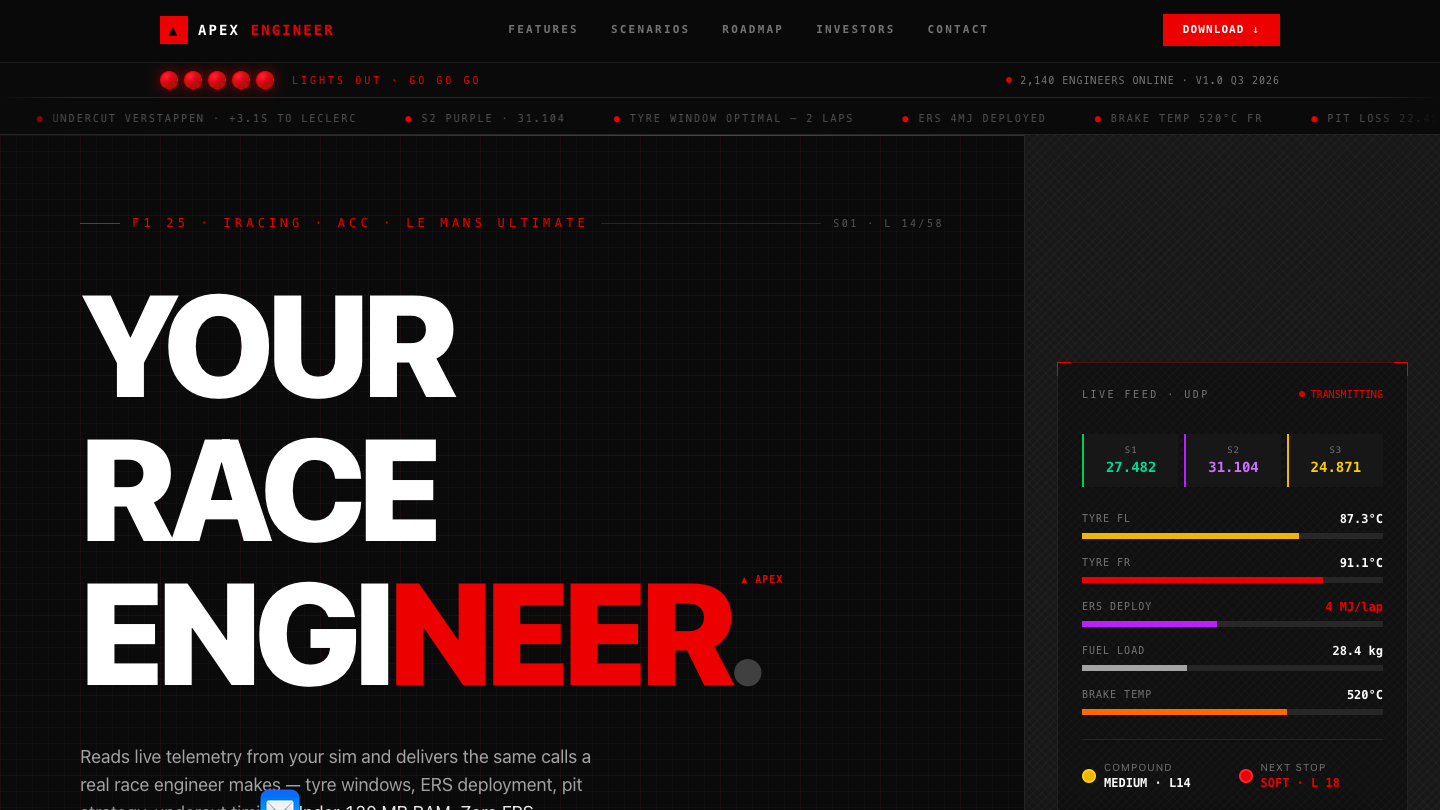
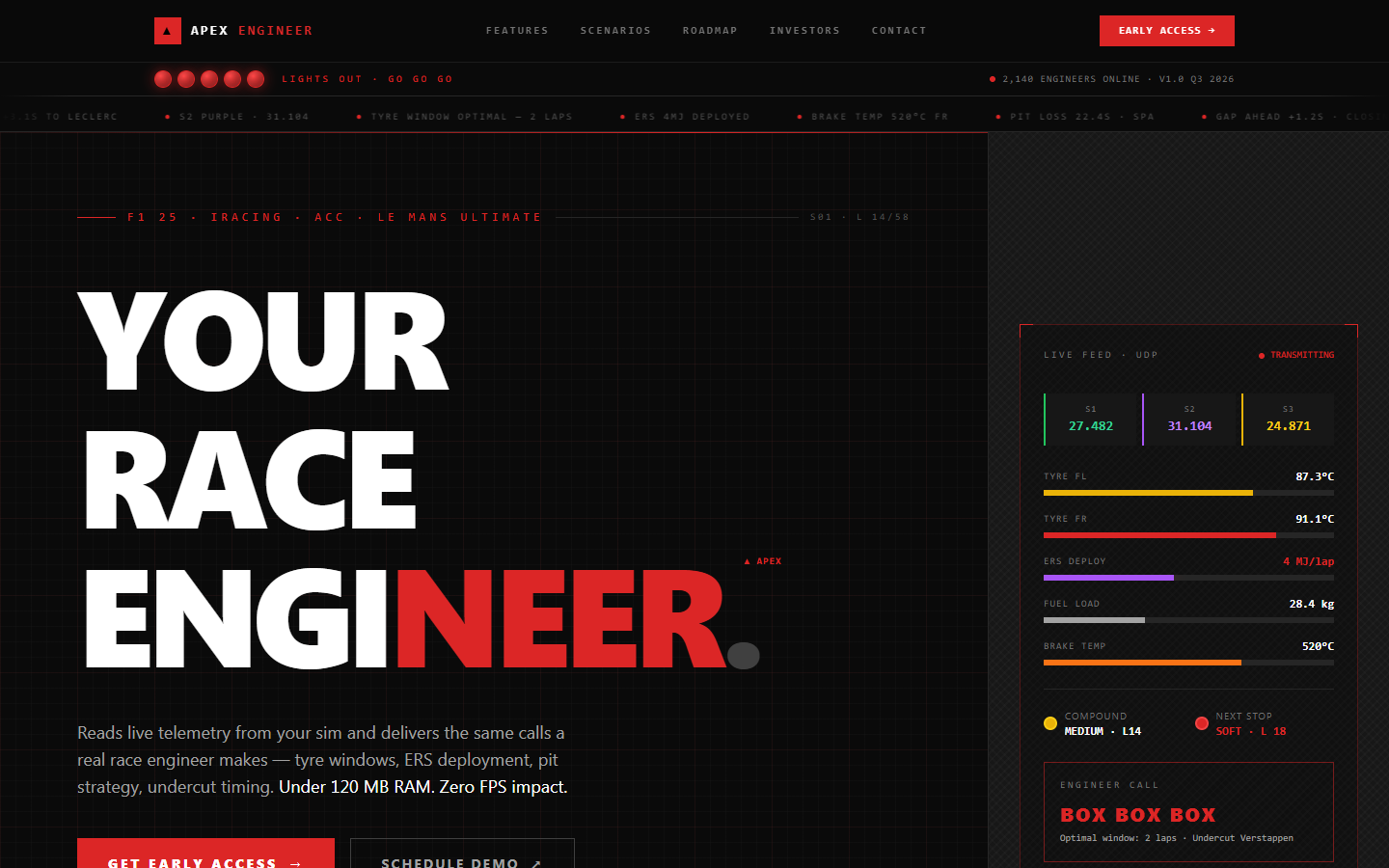
Apex Engineer is a desktop AI race engineer that sits in your ear during practice, qualifying and the race. It reads your live telemetry and makes the same kind of calls a real engineer would: when to push, when to lift-and-coast, where to deploy, and how your energy and tyres are trending against the plan.
For F1 26 specifically, the focus is energy. It watches your state of charge against the track ahead and coaches deployment corner by corner, so your spend lands on the parts of the lap where it converts to real speed instead of bleeding away into drag. The interface is voice-first by design, so your hands stay on the wheel and your eyes stay on the braking marker.
Key capabilities relevant to the 2026 energy game:
- Live race-strategy calls in plain language: push, save, box.
- ERS and battery deployment guidance tuned per corner and per straight.
- Real-time tyre-wear and fuel-delta analysis alongside energy state.
- Weather and safety-car adaptive strategy when the plan has to change.
- Braking-zone and racing-line coaching to protect your harvest.
How it coaches battery, harvest and overtake energy
The useful part is the timing. Apex Engineer tracks where you are on the lap and what is coming next, so instead of a generic 'use your ERS', you get a call that matches the corner. Out of a slow hairpin onto a long straight, it will tell you to hold deployment briefly and then commit as the car goes low-drag, so the energy lands where it adds the most speed.
On the recovery side, it watches your harvest under braking and flags when your balance is off, so the battery actually refills before the next big straight rather than draining lap after lap. When you have overtake energy banked, it helps you time the release into the zone where it counts instead of burning it defensively into clean air.
It is also adaptive. A virtual safety car, a real safety car, a switch to wet tyres, or a long stint that eats your tyre window all change the right energy plan, and the calls change with them. The goal is simple: you keep driving, and the engineer keeps you from arriving anywhere with an empty battery.
Who this is for, and who it is not
Apex Engineer is for sim racers who want to actually improve their energy management and race craft, and who are comfortable running a lightweight companion app alongside the game. It is currently in beta and focused on Formula 1 titles. If you only do the occasional casual race and never look at strategy, you probably will not get the value out of it. And if you race exclusively on iRacing, ACC, or Le Mans Ultimate today, note that broader sim support is on the roadmap rather than shipped. Honest expectations make for happier drivers.
Under the hood
Apex Engineer is built on Tauri with a Rust core, which is a deliberate engineering choice for a tool that has to run while you game. It uses well under 120MB of RAM and is designed to leave your frame-rate untouched, so the engineer never competes with the title you are racing. It reads the game's telemetry stream in real time, reasons about your energy and tyre state, and turns that into the short, timely voice calls that make it useful at racing speed. If you want a deeper view of your data pipeline, our Telemetry Relay tool can fan that same feed out to every app on your rig at once.
FAQ
Why is battery management harder in F1 26 than F1 25?
Because the 2026 rules move a much larger share of total power to the electrical side. In F1 25, ERS was mostly a top-up. In F1 26, electrical deployment is closer to half your performance and it is finite, so balancing harvest under braking against spend on the straights becomes the single biggest laptime and strategy lever on the lap.
What is the most common ERS mistake in F1 26?
Deploying too early. Burying the deployment out of a slow corner feels fast, but it spends energy while the car is still drag-limited, leaving you coasting the last part of the straight with an empty battery. Running flat-out deployment every lap until you arrive at the longest straight with nothing left is a close second.
Does Apex Engineer slow down my game?
No. It is built on Tauri with a Rust core specifically so it runs in well under 120MB of RAM and leaves your frame-rate untouched. It sits alongside the game, reads telemetry in real time, and delivers voice-first calls, so it never competes with the title you are racing for resources.
Does it work with other racing sims?
Today the focus is Formula 1 titles, where the 2026 energy rules make the calls most valuable. Support for more sims, including iRacing, ACC, and Le Mans Ultimate, is on the roadmap. If you race those exclusively right now, keep an eye on the releases page rather than expecting full support on day one.
Get Apex Engineer for F1 26
If energy management is where your lap time is hiding, let an engineer handle the calls while you drive. Try Apex Engineer in beta, read the full breakdown on the Apex Engineer product page, or if you want a team like Krapton to build a real-time desktop tool of your own, hire a dedicated Krapton team.