Most relationship apps hand couples generic advice and hope it sticks. Pademi took the opposite bet: that real connection comes from two people answering the same honest question separately, then discovering what the other actually said. Krapton designed and shipped that experience across iOS, Android, and the web.
TL;DR: Pademi is a relationship-building app that helps couples reconnect through short, meaningful daily interactions — paired conversation prompts, love notes, mood sharing, couple quizzes, and multi-day guided journeys. Krapton built it as a cross-platform React Native app on Firebase, with Redux state management and streak mechanics that keep both partners coming back.
What Pademi Is
Pademi is a relationship-building app for couples who want to strengthen their connection without scheduling a therapy session or wading through generic listicles. Two partners link their accounts with an invite code, and from there the app becomes a shared, private space that belongs only to them.
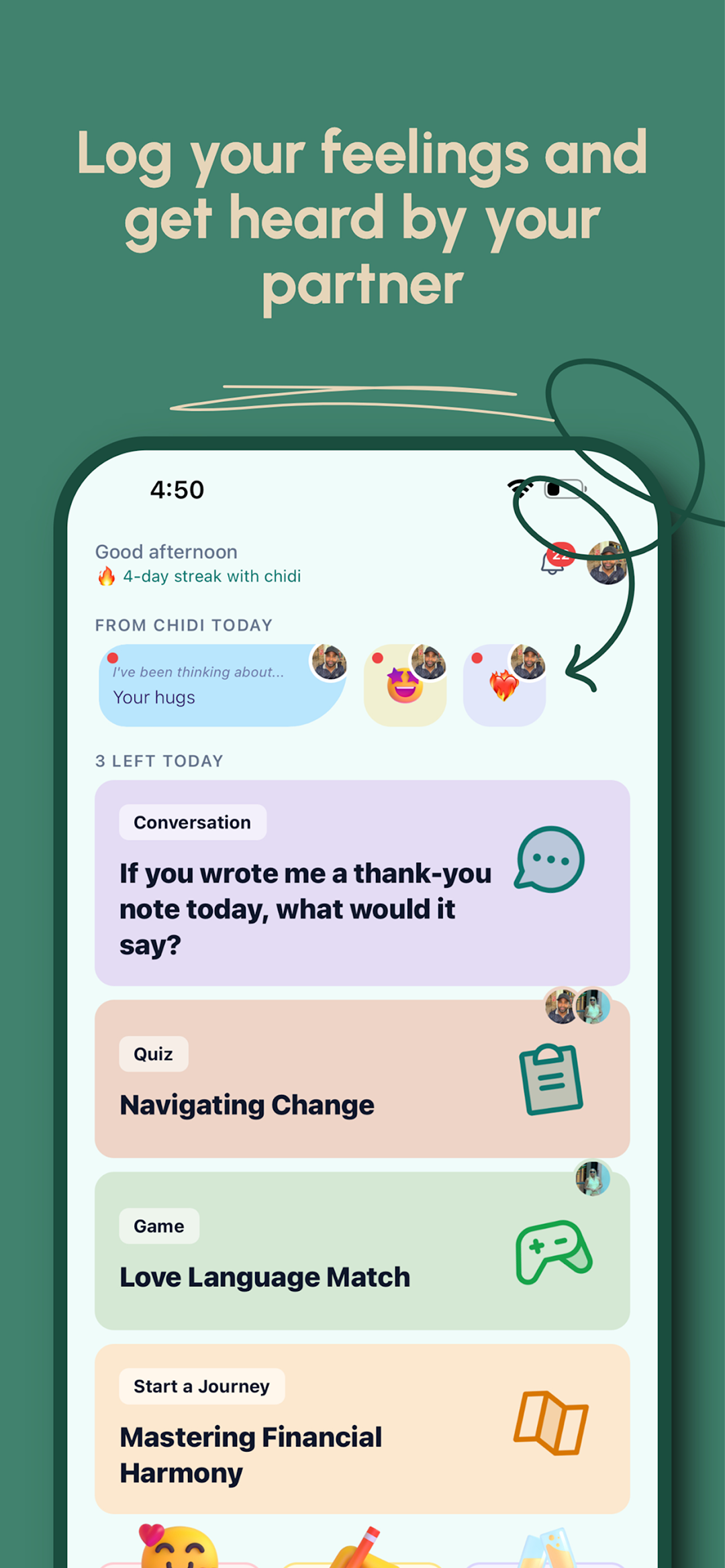
The core loop is deceptively simple. Each partner receives a personalised conversation prompt, answers it on their own, and only then sees how the other responded. That sequence — answer first, compare second — is the whole point. It removes the instinct to soften or mirror your partner's answer and instead surfaces the small, genuine differences that spark real conversation. Around that loop, Pademi layers love notes, one-tap mood sharing, couple quizzes, and guided multi-day journeys.
The Problem It Solves
The brief Krapton worked from was grounded in a real frustration: most couples do not lack love, they lack moments of intentional attention. Day-to-day life crowds out the kind of small, curious questions that actually build understanding. Generic advice apps cannot replicate this because they talk at a couple instead of getting the two people to talk to each other.
Pademi solves that by making connection a low-friction daily habit rather than a grand gesture. A prompt takes a minute to answer. A love note takes ten seconds to send. A mood tap takes one. The design philosophy throughout was to lower the cost of showing up so that consistency, not effort, becomes the thing couples optimise for.
Who It Is For
Pademi is built for couples at any stage who want a lightweight, private way to stay close — long-distance partners separated by time zones, busy couples juggling work and family, and newer relationships still learning each other's inner world.
- Long-distance couples who need shared rituals that survive the gap between video calls.
- Busy partners who want connection that fits into a commute or a coffee break, not a free weekend.
- Couples in a rut who feel they have run out of things to talk about and want a gentle nudge back into curiosity.
It is intentionally not a crisis-intervention tool or a substitute for counselling. It is a habit layer for two people who already want to invest in each other.
Key Capabilities
Krapton built Pademi as a full toolkit rather than a single feature. The experience spans several interconnected modes, all sharing the same paired, private foundation.
- Paired conversation prompts — answer separately, then compare, turning everyday questions into moments of discovery.
- Intentional love notes — send a deliberate message that lands in your partner's private space.
- One-tap mood sharing — let your partner know how your day is going without typing a word.
- Couple quizzes — playful tests of how well you actually know each other.
- Guided multi-day journeys — structured tracks on trust, communication, and intimacy that unfold over several days.
- Streak tracking — a shared streak that keeps both partners consistent and accountable.
- Date-experience browser — a curated way to plan a night out, making the planning itself part of the connection.
How It Works Under the Hood
Pademi runs on a single React Native codebase that ships to iOS, Android, and the web, which let the team move features to every platform at once instead of rebuilding three times. For a product where the value is the shared experience between two devices, real-time consistency matters more than almost anything else.
That is why the backend sits on Firebase. Real-time data sync keeps both partners' views in step the instant a prompt is answered or a note is sent, while authentication and the invite-code pairing flow are handled by the same managed stack — no custom server to operate, and predictable behaviour under load. On the client, Redux gives the app a single, predictable state container, which keeps the paired prompt logic — who has answered, what stays hidden until both respond, when the reveal happens — reliable across screens and sessions.
If you are weighing a similar cross-platform build, our notes on mobile app development walk through the same tradeoffs we made here, and you can see the full Pademi case study for more on the delivery.
A Real-World Usage Scenario
Picture a couple in different cities. In the morning, both get the same prompt — something like what made you feel supported this week. She answers on her commute; he answers over lunch. Neither sees the other's response until both have submitted. When the reveal lands, she learns that a small thing she did barely thought about was the moment he felt most supported — a detail that would never have surfaced over a rushed phone call.
Through the day, he taps a mood to say work is rough, and she sends a love note back without needing the whole story. That evening they extend their streak, and over the weekend the date-experience browser turns into the plan for their next visit. None of it took more than a few minutes, and all of it added up to a couple that feels seen.
Who this is (and is not) for
Pademi is for couples who are willing to show up for a minute or two most days — the value compounds with consistency, and a partner who never opens the app breaks the paired loop that makes it special. It is not therapy, it is not a fix for a relationship in genuine crisis, and it will not do the talking for you. If you are looking for a private, low-effort ritual that keeps two people curious about each other, it fits. If you want passive entertainment or one-sided self-help content, it does not.
FAQ
What does the Pademi app do?
Pademi helps couples strengthen their connection through short daily interactions. Partners link via an invite code, answer personalised conversation prompts separately, then compare responses. It also supports love notes, mood sharing, couple quizzes, multi-day guided journeys on trust and communication, streak tracking, and a curated date-experience browser.
Is Pademi available on iPhone and Android?
Yes. Krapton built Pademi as a cross-platform React Native app, so it is live on iOS, Android, and the web at pademi.io. Because all three share one codebase, the experience and feature set stay consistent no matter which device each partner uses.
How is Pademi different from a generic relationship advice app?
Most advice apps push generic tips at you. Pademi gets the two of you talking to each other instead. The answer-separately-then-compare mechanic surfaces genuine differences between partners, and features like paired prompts, mood sharing, and guided journeys are designed around your specific relationship rather than one-size-fits-all advice.
What technology is Pademi built on?
Pademi is a React Native app backed by Firebase for real-time data sync, authentication, and the invite-code pairing flow, with Redux managing client-side state. That stack keeps both partners' views in sync the moment a prompt is answered and lets a single codebase ship to iOS, Android, and the web.
Build Your Next App With Krapton
Pademi shows what a focused product team can ship when the experience, the platform strategy, and the real-time backend are designed together. If you have a cross-platform app idea that lives or dies on a great shared experience, Krapton can build it. Hire a dedicated Krapton team to take it from concept to the App Store, or visit the live Pademi site to see the result.